
How to Search the Dougherty County Court Docket
Start your Dougherty County court docket search at the Tyler CM Web Search portal. It is run by the Clerk of the Superior and State Courts. The portal indexes Superior and State cases. The forms let you look by Party, Associated Party, or Case Number. First, though, work out which court holds the matter. Options here include Superior, State, Magistrate, Probate, Albany Municipal, Juvenile, and federal court. A Probate file or a city ticket will not show up here. It falls outside this county Superior and State search.
If you know the case number, use it. Otherwise type a party name. Put the last name first. Skip suffixes and use at least two letters. Try spelling variations too, since the portal warns that results depend on what you enter. The Court Code menu offers ST for State. SU means Superior, MG means Magistrate, and NP means Notary Publics.
- Identify the likely court and division before choosing a search form.
- Enter a party, associated party, or four-digit year with the numeric case number.
- Choose Court Code, then let Court Division populate before narrowing the search.
- Use filing dates and Active or Inactive status only when they help reduce a broad result.
- Open the case view, read Proceedings, and confirm unclear entries with the Clerk or court.
Remember that a result is only an index layer. For the exact order, judgment, exhibit, or certified copy, you may need PeachCourt or a direct request. For help with a docket or record question, the Clerk lists 229-431-2198.
Dougherty County Docket Portal Search
The Tyler portal has another strength: its filters map the county's whole court structure. State divisions run from SV Civil and SR Misdemeanor to SW Misdemeanor Warrants. ST Traffic rounds out that list. On the Superior side you will find CV Civil and DW Dismissed Warrants. R Felony, SW Search Warrants, and WT Warrants also appear. Magistrate options cover civil claims, dispossessory, garnishment, commitment, foreclosure, interrogatories, misdemeanor citation, and probation. Treat this list as a map of where to search. It is not a list of outcomes.
Each search type needs something different. Party search wants a party name. Associated Party search keeps a related name apart from the main party. Case Number search takes a four-digit year plus a numeric case number. The form pads the number to six digits. Filing dates, case type, and status stay optional. The name forms run on Search (F8). Clear (F5) wipes the form.
This link goes to the official Dougherty Tyler CM Web Search landing page. That page shows the free public index. It also carries a search disclaimer. Free searching does not promise that every court record or document is online.
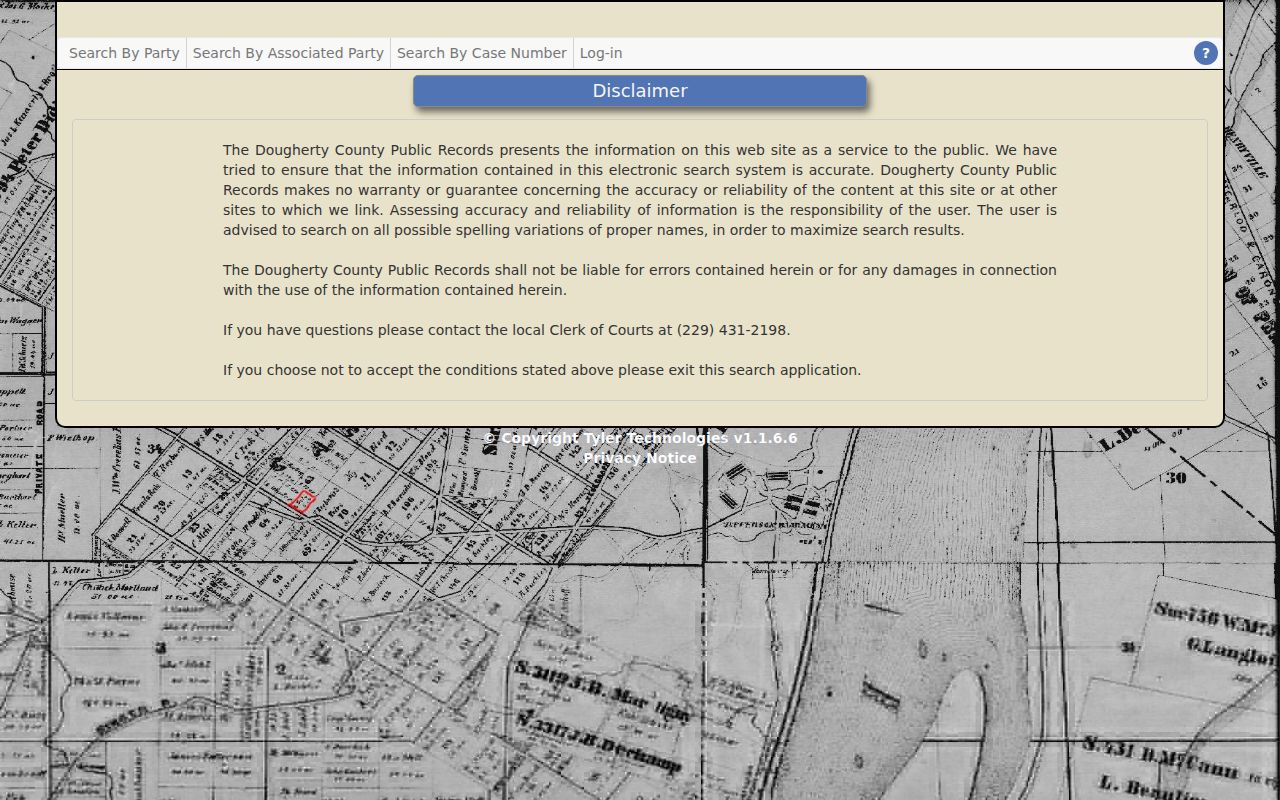
A maximum-result message means your search was too broad. Narrow it with a court code, division, date range, or status rather than repeating the same query.
What a Court Docket Shows
A Dougherty County case view is a summary page with a chronological Proceedings tab. The overview labels include Case Number, Active, Judge, Filing Date, Filling Time, Close Date, and Remarks. Note that "Filling Time" is the portal's own spelling. It is not a separate legal field. Parties and Associated Parties spell out each role. Criminal records add Offenses and statute fields.
The Proceedings tab works like a running docket. A row may show a code and description. Filing date, party name, offense, comments, and a View control may also appear. A View link can open a document image. Not every image is guaranteed to be free or open to every requester. And a calendar row is only a scheduled event, never a judgment.
| Case Number | Local identifier built from court code, division, year, and sequence. |
|---|---|
| Active | A portal status indicator, not a final disposition or finding. |
| Filing Date | Date the case or filing entered the court system. |
| Parties | Party names, role codes, and local flags shown in the case view. |
| Proceedings | Chronological codes, descriptions, dates, comments, and possible View links. |
| Remarks | Overview notes that may point to transfer or related-case information. |
Dougherty County Docket Proceedings
Do not read "Inactive" as acquitted, dismissed, or resolved. It is just a search status. "Dismissed Warrants" labels a Superior division and does not prove any particular warrant was dismissed. A blank Close Date shows nothing either way. Check the latest Proceedings entry, then pull the final order when the result truly matters.
The local reading sequence is header → party roles → offense or civil subject → Proceedings → current calendar → document layer. A criminal reader should compare Offenses with Proceedings. A civil reader should compare Parties with Proceedings and distinguish a motion filing from the signed order. Remarks can reveal transfer or related-case clues without supplying the full legal history.
- Proceedings
- The event list that records local docket activity in time order.
- Disposition
- The recorded outcome or final action, which should be confirmed from the order when unclear.
- Active
- A portal status field that does not by itself establish a legal result.
- View
- A document or image control whose availability can depend on access rights.
- Reset
- A moved setting that does not mean the case was dismissed.
Which Courts Keep Dockets
Dougherty County splits its court records by court level. Superior Court holds felony cases and major civil matters. State Court takes misdemeanors punishable by up to 12 months plus broad concurrent civil jurisdiction. Warrants, committal hearings, and dispossessory live in Magistrate Court. So do garnishment and civil claims up to $15,000. Probate, Juvenile, Albany Municipal, and federal courts run their own offices and search routes.
The Superior Court and State Court pages detail jurisdiction and calendars. The Clerk's unified office sits in Suite 126 of the Judicial Building. State Court is listed in Suite 308. Magistrate materials give differing room details, so call ahead rather than trusting a PDF.
This link opens the official Dougherty State Court page. It shows why the court code and division matter before you read any case result.
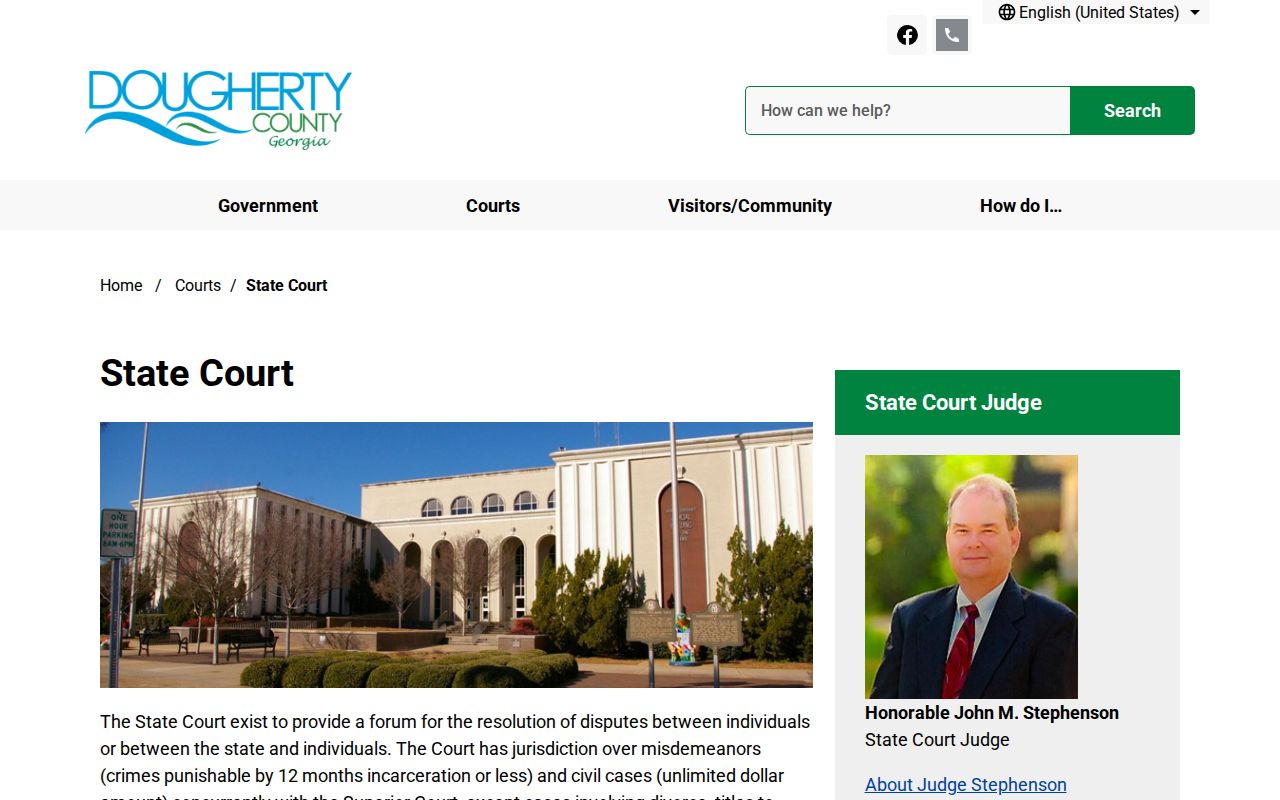
Georgia Courts offers statewide court information, but State Court's civil and misdemeanor calendars stay county-specific.
| Court or office | Common docket scope | Where to start |
|---|---|---|
| Superior | Felony, divorce, land title, equity, major civil | Tyler SU divisions, Superior page, Clerk |
| State | Misdemeanor and concurrent civil | Tyler ST divisions, State page, coordinators |
| Magistrate | Warrants, small claims, dispossessory, garnishment | Magistrate Court office and forms |
| Probate or Juvenile | Estates, guardianship, commitments, juvenile matters | Separate court office; Juvenile access is restricted |
| Albany Municipal or federal | City cases or federal civil, criminal, and bankruptcy | Courtware or PACER and the issuing clerk |
Dougherty County Court Docket Coverage
Georgia has no single statewide docket database. Georgia Courts E-Access works as a provider directory that sends you to the individual court or vendor. Dougherty's Tyler portal covers only its unified Superior and State index. Probate directs users to Georgia Probate Records. Juvenile sends authorized users to JDEX. Albany Municipal Court publishes Courtware and its own records route. Federal cases go through PACER and CM/ECF.
This link leads to the Georgia Courts E-Access directory. Use it to find a provider, not as a stand-in for the local court's own data.
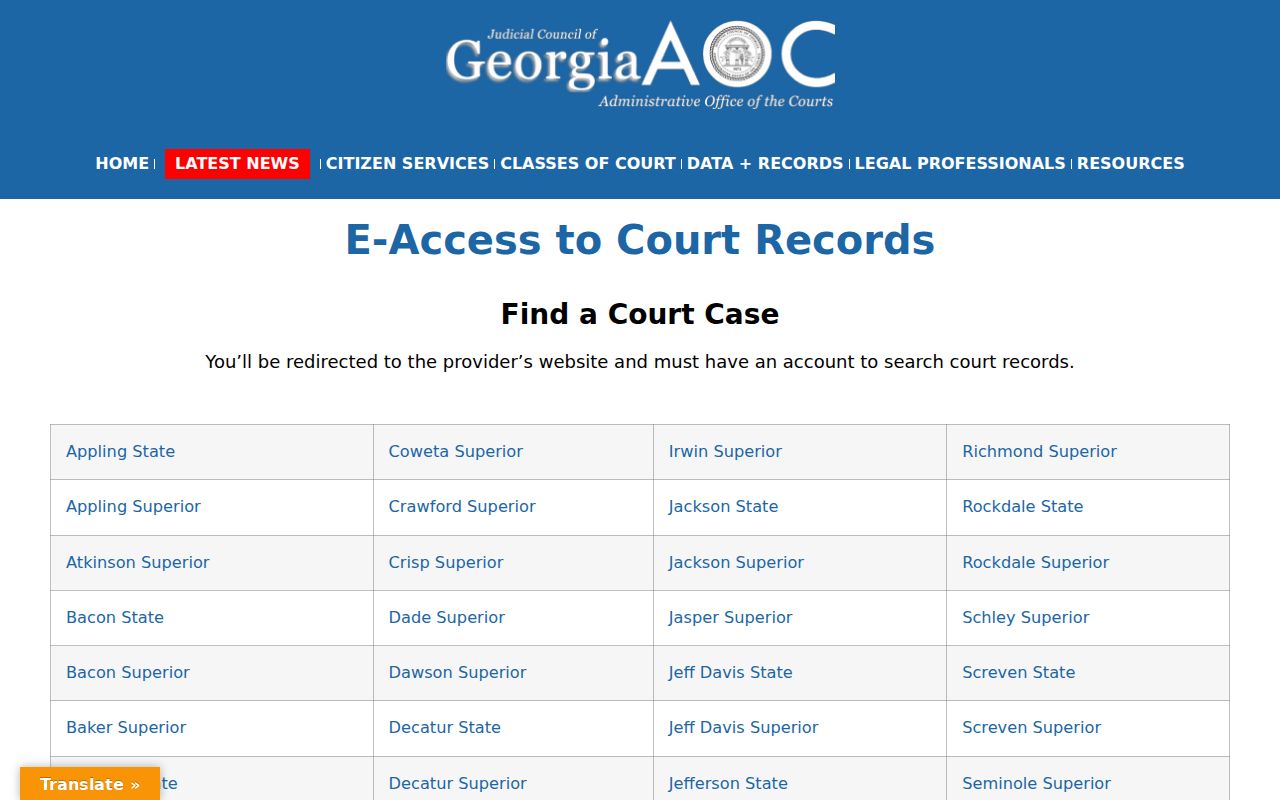
A blank Tyler result means one of several things. The case may sit in another court or division. The file may be restricted or simply not digitized. There may be no matching case at all. Check the custody map before you trust that empty screen. It is not proof the record does not exist.
Albany shows why. A municipal ticket can live in Courtware while Tyler shows nothing. The city system stands apart. County, city, and federal offices all share the same downtown blocks. Neighboring buildings do not merge into one Dougherty County court docket.
Finding Court Dates and Settings
A single hearing can surface in several places. Tyler Proceedings is one option. So are a judge-specific Superior criminal calendar and the annual Superior calendar PDF. A State Court calendar or a Courtware calendar from Albany belongs on the list too. Match the setting with the case number, then read the latest event and any current order carefully. A published calendar only proves a case was scheduled. It never shows that the case went forward or avoided being reset.
The county's 2026 annual Superior calendar names its blocks. Civil Calendar Call, Criminal Trial Week, arraignment, and probation review come first. Child support, Drug Week, Grand Jury Presentments, MHSA, PAC Court/Child Support, Day Reporting Court, and Community Supervision fill out the year. Each label describes a block of court time. It says nothing about eligibility, compliance, or how any case ended. State Court questions go to criminal coordinator Tracie Bennett at 229-431-2152. Civil questions go to Amy Cox at 229-302-3722.
For jurisdiction and calendar context, the official Dougherty Superior Court information is the county's own page on the subject.
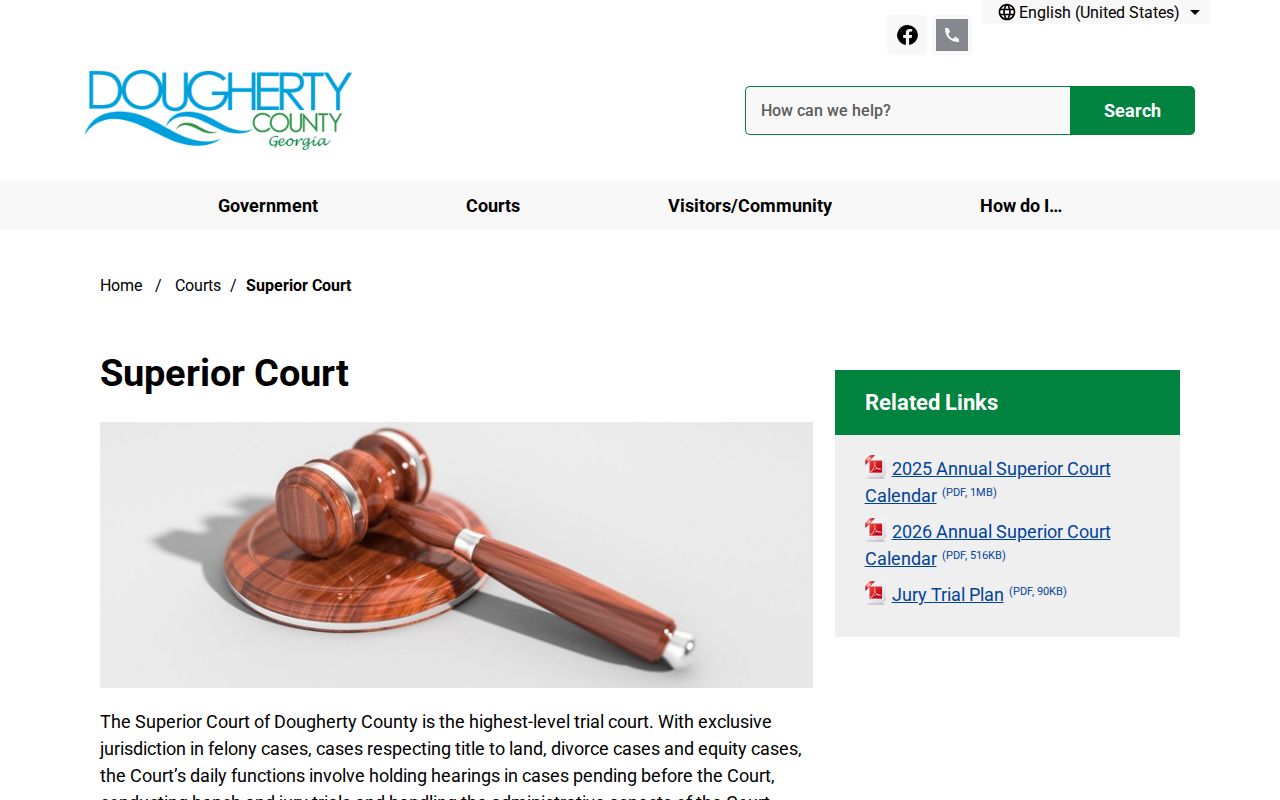
A setting that requires you to appear or file something deserves a live check. Confirm it with the court or its coordinator instead of trusting a stale PDF.
Dougherty County Court Calendar Confirmation
The practical order is current court order or live coordinator → Clerk case record → posted calendar PDF → other calendar display. Superior criminal calendars are organized by judge and may include arraignment, jury-trial, and Drug Week links. State Court publishes annual calendar PDFs and coordinator contacts. Albany Municipal Court uses a master calendar and a live Courtware table with Court Date/Time, Ticket No, Court Date Type, and payment-link fields.
Showing up in person is part of the workflow too. The Judicial Building lobby runs a metal detector and an x-ray machine. Judicial Court Services staffs the building with deputies and civilian bailiffs. Public access guidelines permit in-person proceedings unless a law or court order closes them. Plan extra time for screening and device limits. Follow whatever instruction the court gives that day.
The Georgia Courts Dougherty courthouse guidelines set out those public-proceeding rules. Remember that an online date is only a lead. The issuing court's current notice confirms it.
Public Access to Dockets
Georgia leans toward openness. But statutes, rules, protected identifiers, and court orders can all limit access to court records. Uniform Superior Court Rule 21 governs public access to Superior Court files. Rule 21.1 handles restriction requests, Rule 21.2 privacy balancing, and Rule 21.3 temporary limits. Rule 21.6 shields personal identifiers in specified materials.
The Georgia Open Records Act, O.C.G.A. § 50-18-70 et seq., covers public agency records generally. But the Attorney General notes one thing. Courts follow their own court-record procedures rather than treating every pleading as an ordinary administrative request. A county public-notices contact is not automatically right. Superior or State filings belong with the court's own clerk.
Access rules in plain terms:
Unsealed public court records may be inspected through the court's process.
Juvenile, sealed, in-camera, protected-identifier, and court-restricted material may be absent or masked.
A Tyler entry is not a certified copy and does not guarantee that the document behind View is public.
When access is denied, ask the Clerk or issuing court for the legal basis and available review route.
Dougherty County Court Records Custodians
County open records and court records overlap, but they are not the same job. For administrative open-records questions, Dougherty County lists Jawahn Ware at jware@dougherty.ga.us and 229-431-2121. The Attorney General's court-record FAQ is blunt. A court-file request belongs with the court or its clerk. Route a Superior judgment to an administrative office. You may just lose time without ever reaching the document.
The split runs inside the courthouse as well. Superior and State records both live in Phyllis N. Johnson's unified office. Probate, Magistrate, Juvenile, and Albany Municipal Court each keep their own staff and systems. A federal record sits with the Middle District clerk or PACER. So identify the case family first. Then ask for the copy. Have the court, division, case number, exact event, and preferred copy type in hand.
The official Dougherty Clerk of Court page names the local office behind the main county docket index, and the clerk is the natural first call when Tyler navigation stalls.
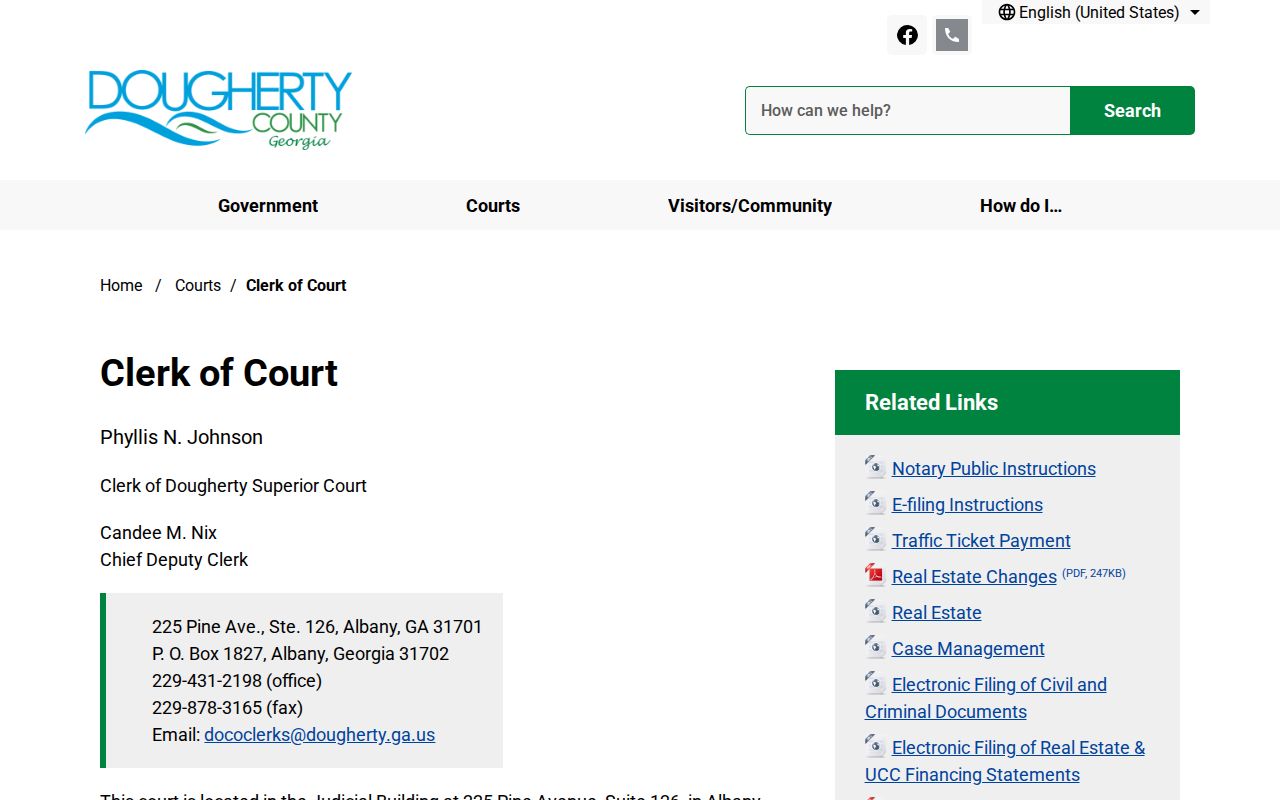
The Clerk's office can tell you what an item actually is. It may be online, on paper, archived, restricted, or held by a different court entirely.
The Clerk and Docket Records
Phyllis N. Johnson serves as Clerk of the Superior and State Courts of Dougherty County. Her unified office keeps the indexes. Superior felony cases, Superior civil filings, and State Court misdemeanor and civil matters all sit there. The office also issues summonses, subpoenas, writs, and executions. It handles jury work and scanning. It performs other statutory duties too. The FY2014 budget once described up to 5,000 document pages filed or recorded in a single day. Treat that figure as historical workload, not a current county total.
Superior and State Clerk
Phyllis N. Johnson
Judicial Building, 225 Pine Avenue, Suite 126
Albany, GA 31701
229-431-2198
P.O. Box 1827, Albany, GA 31702
dococlerks@dougherty.ga.us
Hours: 8:30 a.m. to 5 p.m., Monday through Friday
The Clerk lists fax 229-878-3165 and asks users to call when the portal defeats them. The official pages promise no universal ID rule, no same-day copy guarantee, and no fixed mail turnaround. Ask which channel and fee apply to your exact record before sending anything.
Dougherty County Docket and Filed Documents
Think of the free public index and the filed document as two different tools. The index tells you where things stand. It can show the case number and court. It can also show a party's role, the case status, the filing date, and any proceeding or setting on the calendar. The document itself is different. It may be a motion or an order. It may be a judgment, an exhibit, a transcript, or a certified copy. PeachCourt may carry an electronic file for an authorized requester, and the Clerk may have to pull a paper or archived item from storage.
Copy fees follow a published schedule effective July 1, 2024. Plain copies run $0.50 per page without assistance and $1 per page with assistance. A certified or exemplified copy costs $2.50 for the first page. Each additional page adds $0.50. Computer printouts are $2.50 per page or equivalent. A faxed or electronic copy is $2.50 for the first page plus $1 for each additional page. Confirm the schedule before you pay anything.
Need the full filing history instead of just a spot in the docket? Move from the case index to Dougherty County court records. Only trying to locate a case? Use the county case search first, then verify what you find with the Clerk.
Court Dockets by City in Dougherty County
Dougherty County has exactly one incorporated city: Albany. Its 2020 incorporated-place population was 69,647. The county's own solid-waste plan names Albany as the sole incorporated municipality. Albany is also the county seat. Its municipal court is the one city-court branch that gets its own page here.
Albany Municipal Court handles city ordinances and city misdemeanors. It also handles state traffic matters on a calendar and record path of its own. Its Courtware system is separate from the county Tyler index. The payment and administrative office sits at 240 Pine Avenue, Room 150. Hearings usually happen at the Albany Law Enforcement Center, 201 W. Oglethorpe Boulevard, though in-custody arraignments can take place at the Dougherty County Jail. The city page gathers all of this municipal detail in one place.
Albany Court Docket
Search the Albany Municipal Court calendar, identify city traffic and ordinance records, confirm city court dates, and follow a city case when it remains separate from the county Tyler portal.
Dougherty County Federal Court Docket
Federal cases live on a separate layer from the Dougherty County court docket. The Albany Division of the U.S. District Court for the Middle District of Georgia serves the county. It operates from the C.B. King U.S. Courthouse at 201 West Broad Avenue, Albany, Georgia 31701. The federal office lists phone 229-430-8432. Hours are 8:30 a.m. to 5 p.m., Monday through Friday. Bankruptcy matters go through the federal bankruptcy court's Albany location.
Public access to federal cases runs through PACER. CM/ECF is the underlying filing and case-management system. PACER's published pricing is $0.10 per page. The fee is capped at $3 for a case-specific document or docket report, subject to stated exceptions. For current terms, check the official PACER pricing page. CourtListener and RECAP mirror some federal documents for free, but coverage is spotty. The official docket always controls.
County, city, state, and federal courthouses all sit within a short walk of one another in downtown Albany. Each still keeps its own docket. That closeness is useful context. It is not a reason to assume one search form covers every court.
Map and Directions to the Judicial Building
Superior Court felony, Superior civil, and State Court misdemeanor/civil dockets are kept at the Judicial Building, 225 Pine Avenue in downtown Albany, where the unified Clerk of Superior and State Courts works out of Suite 126. The same complex houses State Court in Suite 308, Probate Court in Suite 123, and Magistrate Court in a room the official pages list inconsistently as either 310-C or 308, so confirming the room by phone before a Magistrate visit is worthwhile. The public law library and Southwest Georgia Legal Self-Help Center, Room 209, are in the same building for anyone navigating a form without an attorney.
Superior and State Clerk
Judicial Building, 225 Pine Avenue, Suite 126
Albany, GA 31701
229-431-2198
Hours: 8:30 a.m. to 5 p.m., Monday through Friday
The Sheriff's Judicial Court Services page confirms lobby screening with a metal detector and x-ray machine and bailiffs staffing Superior, State, Magistrate, and Juvenile courtrooms, so visitors should not plan on bringing recording devices or large bags into a courtroom.