
How to Get Court Records
Start with the Dougherty Tyler CM Web Search for a Superior or State case. You can search by party, associated party, or case number. Write down the court code, division, case number, and any filing or proceeding date. Add the exact description of the item you want. A View control sometimes opens a document image. The court does not promise that every image is free or open to every requester.
If the file stays hidden, try another channel. PeachCourt handles e-filing and document access for the county. The Superior and State Clerk also takes questions at the counter. It publishes phone, email, fax, and mail contacts. Not every copy type is available through every remote route. Call before you mail money or assume an email attachment will do.
- Search the Tyler index and write down the court, division, case number, and event description.
- Check PeachCourt when the requester is a party or has the account access the document requires.
- Call 229-431-2198 when a View link is blank or the file may be paper, archived, sealed, juvenile, or held elsewhere.
- Ask for plain, certified, or exemplified treatment and confirm the fee before submitting a request.
- Use the custodian's accepted counter, mail, email, or fax route and retain the case and document description.
Dougherty County Court Record Documents
PeachCourt is not the free Tyler docket index. The Clerk's e-filing instructions say civil e-filing has run for years. Criminal e-filing was opened to all parties during the COVID-era crisis. Case parties can eFile and download criminal documents at no cost under the county's instructions. Non-parties pay the same as they would for paper copies from the Clerk.
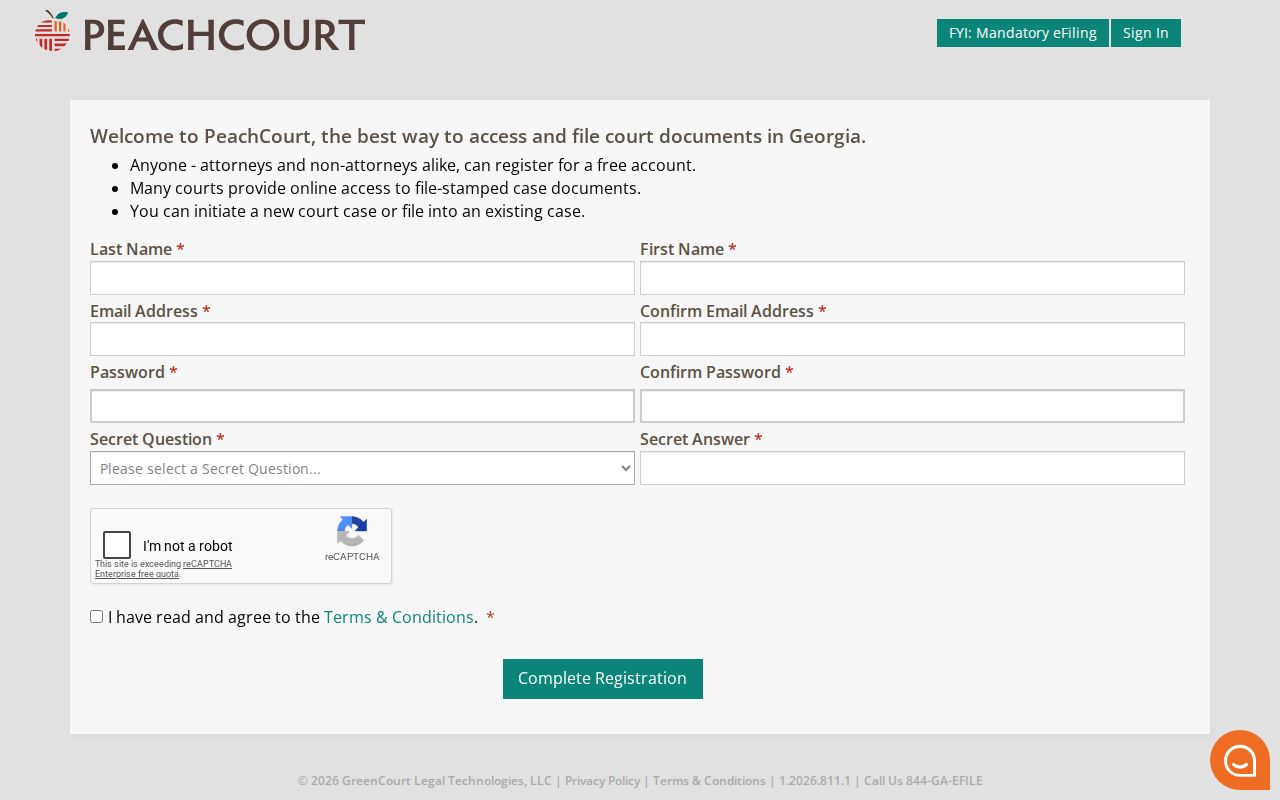
The provider's access page requires an account for e-access. Its registration page describes free account creation. Free sign-up does not make every document public or free. A sealed pleading or a restricted identifier can still require the Clerk or a court decision. So can an old paper file, or a document never digitized into the provider.
This image links to the official PeachCourt registration page. That official page shows the provider layer that may sit behind a Dougherty County docket entry. Treat the account as a document-access option. It is not proof that a whole case file is online.
The Clerk's office is the fallback when a provider does not supply the requested record.
Types of Court Records
A court docket or index is one product. It lists the case, the parties, status fields, proceedings, and event descriptions. A filed document is a different product: a pleading, motion, order, judgment, exhibit, or citation tied to a proceeding. Then there is the certified or exemplified copy, a clerk-authenticated version made for formal proof or filing. A plain printout is neither of those authenticated products.
Which office holds the record depends on its type. The Superior and State Clerk keeps county civil, felony, and misdemeanor case records. Probate keeps estates and guardianship matters. Juvenile keeps confidential delinquency and dependency files. Albany Municipal Court holds city ordinances, city misdemeanors, and city traffic matters. Hearing transcripts come from the court reporter. Federal civil, criminal, and bankruptcy records run through PACER and the federal clerk.
| Record product | What it can show | Likely first custodian |
|---|---|---|
| Docket or index | Case number, status, parties, filings, events, and settings | Tyler, Magistrate, Probate, Municipal, or federal docket system |
| Filed document | Pleading, motion, order, judgment, exhibit, or citation | PeachCourt, Clerk, court office, or paper archive |
| Certified copy | Authenticated copy with the clerk's certification treatment | Clerk or court that maintains the record |
| Transcript | Record of testimony or a hearing | Assigned court reporter or court process |
Dougherty County Court Record Layers
Keeping index, document, and certified copy separate makes a request precise. The Tyler view may tell you a judgment was entered. It may not give you the signed judgment. PeachCourt may show a downloadable file to an authorized requester. The Clerk may need to pull a paper or archived copy. A certified copy adds the clerk's authentication. That is a separate step with its own fee treatment.
Ask for the smallest record that answers the need. A docket sheet often covers the case timeline. The signed order holds the ruling. A certified judgment serves a formal filing. A transcript must be requested from the reporter. Do not assume it comes with a normal Clerk copy.
- Docket
- An index or event record showing what the court system records about a case.
- Filed document
- The pleading, order, judgment, exhibit, or other item tied to a case event.
- Certified copy
- A copy authenticated by the custodian that maintains the record.
- Exemplified copy
- A further formal copy treatment listed with certified-copy services, when requested and available.
What a Court Record Contains
A Dougherty public case view can show overview fields like Case Number, Active, Judge, Filing Date, Filing Time as displayed, Close Date, and Remarks. Parties and Associated Parties carry role fields. Proceedings list a code, description, filing date, party name, offense when relevant, comments, and View. Criminal cases add offense and statute fields. Civil cases read mainly through party, proceeding, setting, order, and judgment information.
Read the fields in order and you will avoid a common error. Confirm the court and division first. Check the party roles next. Then find the most recent proceeding and compare it with the current calendar. Active is not a final result. A blank Close Date does not prove nothing happened. And a View link is not proof that the underlying file is public.
| Overview | Case number, active status, judge, filing date, filing time, close date, and remarks. |
|---|---|
| Parties | Party name, party code, active flag, and other local role fields. |
| Associated Parties | Related party name and code separate from the primary party list. |
| Proceedings | Code, description, filing date, comments, and a possible document view. |
| Document layer | The filed image or copy that must be obtained from the authorized source. |
Certified Copies and Fees
The fee schedule covering both Superior and State cases took effect July 1, 2024. Treat it as a guide, not a guarantee. Amounts can shift. The schedule separates an uncertified copy you make yourself from one made with staff help, and it prices computer, faxed, electronic, certified, and exemplified copies differently. Before mailing any payment, confirm the exact item and the current amount with the Clerk.
| Request | Published amount or treatment |
|---|---|
| Uncertified copy without assistance | $0.50 per page |
| Uncertified copy with assistance | $1 per page |
| Certified or exemplified copy | $2.50 first page, $0.50 each additional page |
| Computer printout | $2.50 per page or equivalent |
| Faxed or electronic copy | $2.50 first page, $1 each additional page |
| Certificate of pending action or unsatisfied judgment | $3 |
Some filings carry fixed prices on that schedule. A Superior civil, modification, or garnishment filing runs $228. A post-judgment filing more than 30 days old, or one opening a new case, costs $62, and a subpoena is $5. Those numbers cover filing or service only. They are not a blanket charge for every docket search. The published material says nothing about a universal ID rule, mail turnaround, accepted payment methods, or an emergency certification surcharge, so ask the Clerk directly.
Dougherty County Missing Court Records
A blank spot can appear where a View control should be. It can mean several things in a Dougherty County court docket. The record could be sealed or juvenile. It might sit in an archive, undigitized, or with Probate or Municipal Court instead. Some files open only to a party or an authorized account. Before assuming the worst, check the spelling, court code, division, case number, and status. Then ask the Clerk directly. Ask whether the item is electronic, paper, restricted, or held by another office.
The public fallback chain is search → identify the exact event → check PeachCourt where available → call the Clerk → visit Suite 126 → send a narrow mail, email, or fax request after confirming the channel and fee. Do not treat a blank result as proof that no case exists. It can also mean the case belongs to Albany Municipal Court, Probate, Juvenile, federal court, or another local division.
Request detail: Before calling, write the court, division, case number, event description, date, requested copy type, delivery method, and your contact information.
Dougherty County Clerk Court Records Office
One counter handles most Dougherty County court records: the unified Superior and State office. It covers Superior civil cases, Superior felonies, and State misdemeanor or civil filings. If the portal confuses you, the Clerk's public guidance says to call. Plan for security screening at the courthouse door. The official pages make no promise about public terminals or same-day copies. Build in extra time for a records request.
Superior and State Clerk
Phyllis N. Johnson
Judicial Building
225 Pine Avenue, Suite 126
Albany, GA 31701
229-431-2198
dococlerks@dougherty.ga.us
Hours: 8:30 a.m. to 5 p.m., Monday through Friday
For copy requests, the Clerk also lists P.O. Box 1827, Albany, GA 31702, and fax 229-878-3165. Confirm the office can handle your request by mail, fax, or email. Do this before you send payment. The county public-notices route fits administrative county requests, not court-file requests.
This link leads to the official Dougherty Probate Court page. Probate records live with a separate custodian and its own online direction. A county-wide Tyler result is never a full search. That is why it cannot cover every Dougherty County court record.
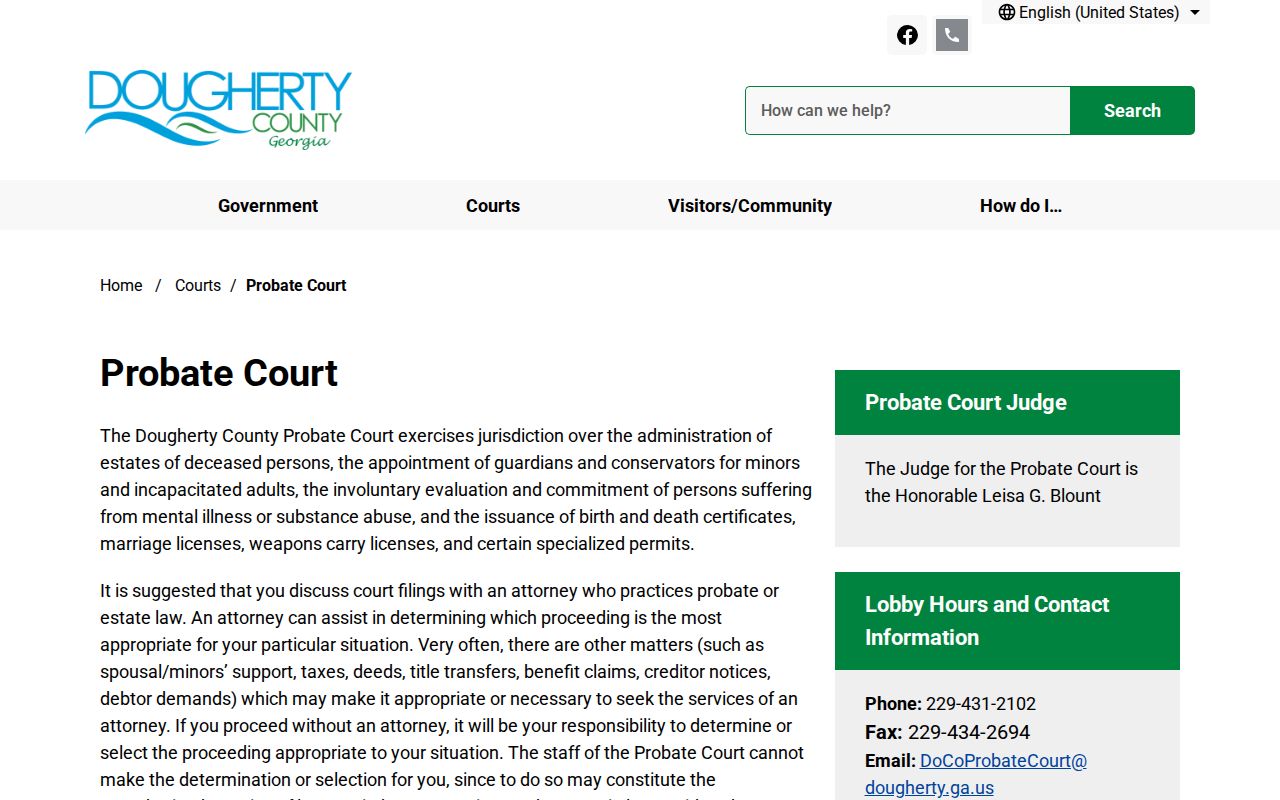
Keep the Superior and State request for those county records only. Route Probate, Juvenile, Municipal, and federal court records to their own offices instead of folding them into one filing.
Public Access and Sealed Records
Georgia's public-access rule comes with limits. Uniform Superior Court Rule 21 backs public access to ordinary Superior Court records. Rules 21.1 through 21.6 then cover restriction requests, balancing tests, temporary limits, and protected identifiers. Juvenile delinquency, dependency, and treatment records sit behind restricted access through Juvenile Court and JDEX.
The Georgia Open Records Act, O.C.G.A. § 50-18-70 et seq., governs public agency records. The Attorney General's court-record FAQ, though, treats court procedures as a separate matter. A clerk might deny you a court record. Ask for the legal basis or the order behind it. Never bypass a restriction. Never publish private identifiers from an open document.
Custodian rule: A court-file request goes to the court or clerk that maintains the case. An administrative county open-records request does not automatically produce a filed pleading, judgment, transcript, or sealed document.
Dougherty County Federal Court Records
Federal cases live in a different layer of the court system. The Albany Division handles them for Dougherty County. It belongs to the U.S. District Court for the Middle District of Georgia. Federal filings sit in PACER and CM/ECF. That covers civil, criminal, bankruptcy, and appellate cases in the federal system. The Dougherty Tyler portal does not hold them. Most people use that portal for county dockets. The C.B. King U.S. Courthouse sits at 201 West Broad Avenue in Albany. The federal clerk's published phone number is 229-430-8432.
Costs work differently here too. PACER pricing sets the rate at $0.10 per page for case information and documents. A case-specific docket or document report is capped at $3, subject to stated exceptions. If your usage in a quarter is $30 or less, the fees are waived. Free help exists: CourtListener and RECAP mirror some federal filings at no charge. Coverage is spotty, though, and the official PACER docket always controls.
The Dougherty County public-notices page marks the administrative open-records route. Use it for county matters rather than federal ones. That process is separate from a court-file request and separate from PACER access.
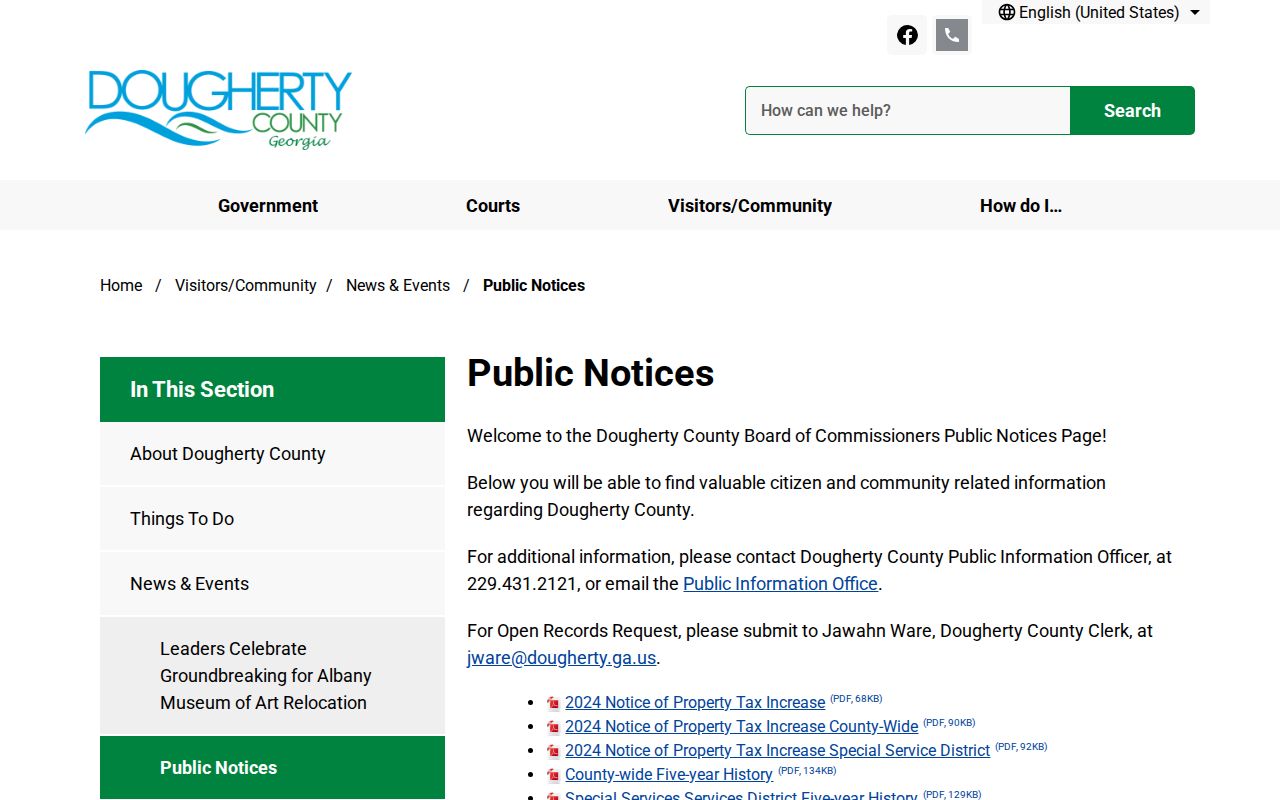
This county administrative route is not PACER and not a request filed with the Clerk.