
How to Search Civil Dockets
Superior and State civil matters start in one place. The public entry point is the Dougherty Tyler CM Web Search portal. Pick Party or Case Number search, then choose the court code before the division. Superior civil matters use SU and CV Civil. State civil matters use ST and SV Civil Division. A party search needs last name first name, no suffix, and at least two letters. If the first pass misses, try spelling variations.
A known case number beats a name search, since common names collide easily. The portal also allows an optional filing-date range plus an Active or Inactive status filter. Small claims, dispossessory actions, garnishments, foreclosures, and similar lower-court cases sit elsewhere. Start with the Dougherty Magistrate Court. Do not assume the Tyler civil list shows them.
- Identify Superior, State, Magistrate, Probate, municipal, or federal custody before searching.
- Enter the party name in last-first order, or enter the four-digit year and numeric case sequence.
- Choose the court code, then narrow the dynamic division list to CV, SV, or the applicable Magistrate division.
- Open the case view and read Parties, Associated Parties, Proceedings, Remarks, and any available View control.
- Call the Clerk or court coordinator when an entry is old, restricted, missing, or unclear.
Dougherty County Civil Docket Starting Points
Dougherty County runs more than one civil docket lane. Superior Court keeps divorce, title to land, equity, and other major civil cases. State Court holds broad concurrent civil jurisdiction, including cases with no stated dollar ceiling, outside the subjects reserved to Superior Court. Magistrate Court takes civil claims up to $15,000 and posts its own forms and fees for small claims, dispossessory cases, garnishments, and related proceedings.
The split matters in practice. A result in one division does not rule out a case in another court. A claim that began in Magistrate Court never becomes a Superior case. The parties sharing a county changes nothing. Albany Municipal Court owns city ordinance matters. Bankruptcy or federal civil actions belong to the federal system. The Georgia Courts E-Access directory can point you to a provider, though it is not a statewide result database.
| Starting point | Typical civil scope | Search or request route |
|---|---|---|
| Superior Court | Divorce, land title, equity, felony-related civil matters, and major civil cases | Tyler portal, Clerk of Superior and State Courts, or court record request |
| State Court | Concurrent civil jurisdiction except subjects reserved to Superior Court | Tyler portal, State Court coordinator, or Clerk |
| Magistrate Court | Claims up to $15,000, dispossessory, garnishment, and related divisions | Magistrate Court office, form, or published fee schedule |
What a Civil Docket Shows
The Tyler civil case view is a case summary with an event timeline. You get the case number, Active status, and judge. Filing date, Filing Time label, Close Date, and Remarks round out the summary. Parties and Associated Parties spell out the roles and related entities. Proceedings lists a code, description, filing date, and party name. Comments follow. A View control appears when an electronic document path exists.
On a civil matter, the Offenses tab is generally the useless part of the screen. First, confirm the court and division. Review the party roles. Then read Proceedings from the earliest filing to the most recent event. A blank Close Date proves nothing about what happened. The Active checkbox is a portal status, not a ruling on the merits.
| Case Number | The local identifier formed from court, division, year, and sequence. |
|---|---|
| Filing Date | The date a case or filing entered the court system. |
| Parties | Names and role codes for the people or entities in the case. |
| Proceedings | Chronological event descriptions, dates, comments, and possible document views. |
| Remarks | Overview notes that may point to transfer or related-case information. |
| Close Date | A populated closure field, not a substitute for reading the final order. |
Dougherty County Civil Docket Timeline
A useful civil reading order is Filing → Service or citation → Answer or response → Motions → Orders → Calendar call or trial → Judgment or other final event → Post-judgment activity. The public docket may show an entry for each step, but the wording can be brief. A proceeding that says “motion filed” is not the same as a signed order granting relief. A trial setting is not a judgment, and a judgment is not necessarily the end of collection or appeal activity.
Start with the most recent event. Work backward from there to see how the case reached that point. A setting changes that. Compare the case view against the annual or judge-specific calendar. The county's 2026 Superior calendar uses labels like Civil Calendar Call and Civil Trial Week. Those labels mark scheduling blocks, not the outcome of any particular case. A document may decide the question. If so, use Dougherty County court-record access to request the actual order, judgment, or certified copy.
Reading sequence: court and division → party roles → filing date → latest Proceedings entry → setting or order → document layer.
Types of Civil Cases on the Docket
Civil docket labels tell you which court owns a case. The local court map gives Superior Court exclusive territory. Divorce, title to land, and equity live there. State Court carries unlimited-dollar concurrent civil jurisdiction outside those Superior-only categories. Magistrate Court's civil divisions cover civil claims, dispossessory cases, garnishments, foreclosure, interrogatories, and commitments. Probate Court handles estates and guardianship. It skips ordinary contract or tort cases.
The categories also explain a blank search. A probate estate may never appear in the Tyler civil division. A dispossessory case may sit in Magistrate Court. Albany Municipal Court holds city ordinance cases, and a federal civil action uses PACER. So search by subject and by the office that keeps the record. County name alone is not enough. The local court map is part of the answer.
- Superior civil: divorce, land title, equity, and major civil jurisdiction.
- State civil: concurrent civil matters outside Superior's exclusive subjects.
- Magistrate civil: claims up to $15,000, dispossessory, garnishment, and related filings.
- Probate: estates, guardianships, conservatorships, commitments, and related records.
- Federal or municipal: separate courts with separate portals and custodians.
When a division is unclear, trust the court's own label. Local codes beat a broad guess about the type of lawsuit every time.
Dougherty County Magistrate Civil Dockets
Small claims in this court follow a set path. The Dougherty Magistrate small-claim form shows every field behind a lower-court filing. A statement of claim, a summons, and an oath appear on it. So do answer information and hearing instructions. The defendant must answer within 30 days after service. After an answer comes in, the court sets a hearing. That is the usual docket workflow, not a promise that every case moves at the same pace.
Civil claims in Magistrate stop at a $15,000 ceiling. One detail deserves a phone call. The form points to Room 310-C, while the fee schedule lists Room 308. Call the Magistrate Court at 229-431-3216 before visiting. A stale PDF is a poor guide to a room number. Confirming beats guessing.
The official Dougherty Magistrate Court information page places the lower-court civil docket in its own local context. That lane is separate. The Magistrate route stays apart from the Superior and State Tyler civil index.
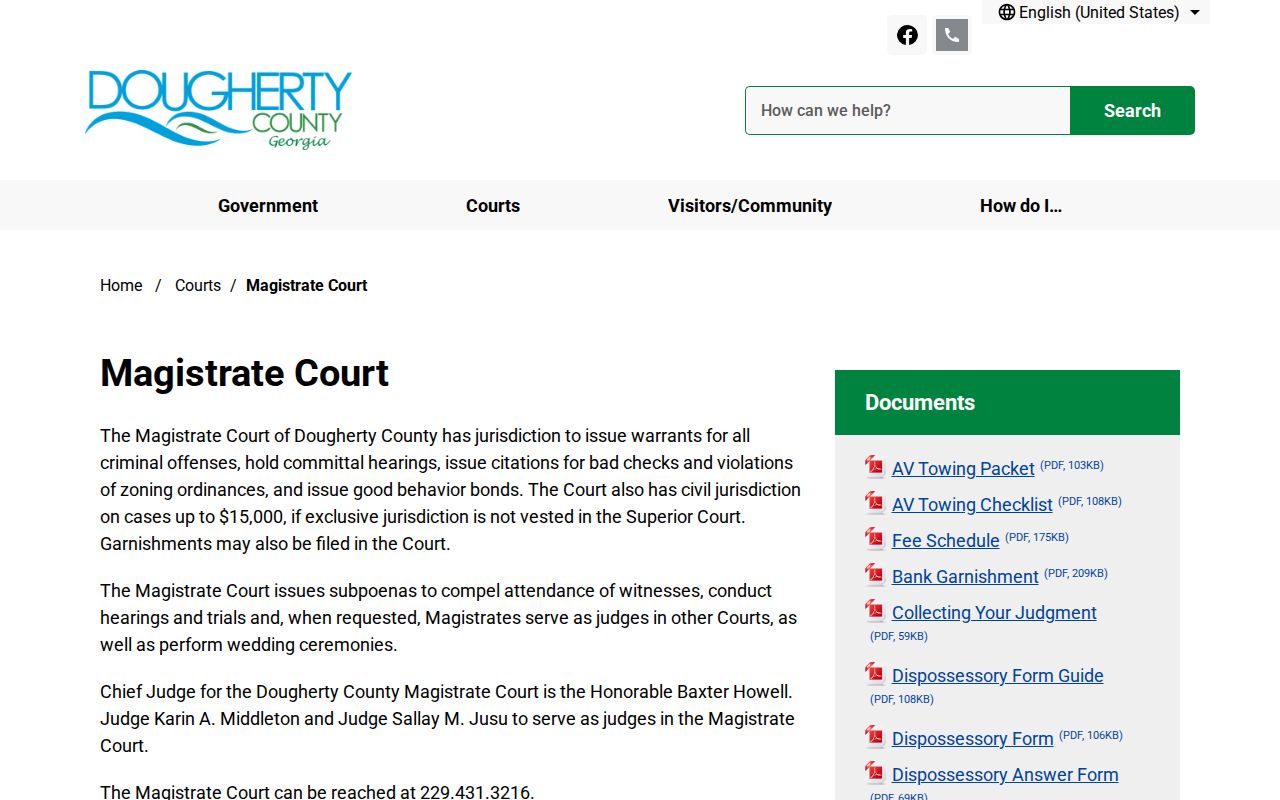
Skip the broad county search when a small claim or dispossessory filing is missing from Tyler. The lower-court office itself is the right fallback.
Settings and Hearings on Civil Dockets
A civil setting is a scheduled court event. It might be a calendar call, a motion hearing, or trial week. The county's annual Superior Court calendar assigns monthly blocks for Civil Calendar Call and Civil Trial Week. That calendar sketches the court's schedule. It is not a case-specific list. Nor does it prove a case was never reset.
When a Tyler Proceedings entry clashes with a posted PDF, the current court order or the coordinator wins. State Court lists civil coordinator Amy Cox at 229-302-3722 and Acox@dougherty.ga.us. For Superior matters, check the judge-specific calendar page or the Clerk line at 229-431-2198. Cases move after a PDF goes up.
| Docket item | What it tells you | What it does not prove |
|---|---|---|
| Calendar Call | The court is organizing or managing cases for a trial setting. | That trial will occur on that date. |
| Trial Week | A block is reserved for civil trials and related court work. | A particular case will not be continued. |
| Motion entry | A filing or scheduled argument may exist. | The judge granted the requested relief. |
Dougherty County Civil Docket Orders
The most common civil reading error is treating a motion entry as the court's decision. A motion is only a request. An order is the ruling. Tyler may show a Proceedings description, comments, or a View control yet still offer no free certified image of the signed order. PeachCourt may hold the document layer. The Clerk may instead need to pull a paper, archived, restricted, or non-digitized file.
Write down the case number, court code, division, event description, and filing date first. Then call the Clerk. Ask whether the item is an order, judgment, pleading, exhibit, or certified copy. When your answer turns on exact language, a short event label will not settle it. The Clerk's office can explain the accepted request channel and the fee for the document. That is a cheap way to avoid a wasted trip.
- Proceedings
- The local chronological event list inside the public case view.
- Motion
- A party's request for a court action, not the court's ruling.
- Order
- The court's signed direction or decision on a matter.
- Calendar call
- A scheduled court call used to organize pending cases.
Public Access to Civil Dockets
Georgia presumes court files are open to the public. Courts still do not treat them like executive-agency paperwork. Uniform Superior Court Rule 21 governs access to Superior Court records. Rules 21.1, 21.2, 21.3, and 21.6 layer on restrictions, balancing, temporary limits, and protected identifiers. So a public search may omit some things. It can leave out juvenile files, sealed material, in-camera evidence, and protected personal identifiers.
The Georgia Open Records Act, O.C.G.A. § 50-18-70 et seq., is an administrative-record route. The Attorney General's court-record FAQ cautions that courts apply their own access procedures. A request for a filed court document belongs with the Clerk or court. It does not go automatically to the county's administrative open-records office.
Access rule: A public civil docket entry does not guarantee that every document behind a View control is public, free, complete, or certified. Ask the Clerk for the legal basis when an item is restricted or unavailable.
Dougherty County Civil Record Routes
The Superior and State Clerk publishes several access channels. Search online first. A counter question, plain copy, or certification request takes you to Suite 126 in the Judicial Building. The office lists phone 229-431-2198, fax 229-878-3165, email dococlerks@dougherty.ga.us, and P.O. Box 1827, Albany, GA 31702. The official pages do not promise that every copy type can be handled by fax or email. Confirm before you send payment.
PeachCourt handles county civil e-filing and document access. Parties may see more than non-parties. A plain copy costs $0.50 per page unassisted and $1 per page with assistance under the schedule effective July 1, 2024. Certified or exemplified copies run $2.50 for the first page and $0.50 for each additional page. Confirm the amount before relying on an old schedule.
Keep the request narrow. List the court, case number, exact filing or order, date if known, plain or certified copy, delivery method, return address, and your contact details. Probate, Juvenile, municipal, and federal cases belong with their own offices. The right office is part of a successful Dougherty civil docket search.